
The recorder lesson
Classes and concert days
Parent meeting
Before new pupils start, I make an appointment with the parent(s) for a meeting lasting about an hour. In this, they get all the information they need to make a good start with their child. They are given the CD or mp3s with the music from books 1 and 2 to take home plus all the lyrics of the songs so they can already start singing them at home. Then there are two more lessons with the parent alone, as preparation before the pupil starts the lessons.
Individual lesson
The lessons are basically individual and 20 minutes long at the beginning. If it suits, I make a combination of two students in a 40-minute lesson, but even then the principle remains that they have individual lessons and thus basically ‘observe’ each other's lessons.
At the start, for a number of lessons, lesson time is divided between parent and child. Because the parent also receives recorder lessons, he or she knows exactly what the child is learning and can therefore better supervise it at home. During the child's lesson, the parent takes notes and is expected to be attentive.
When the student is a bit more advanced - after one or two years - it is at such a level that a 30-minute lesson time is desirable.
Group lesson
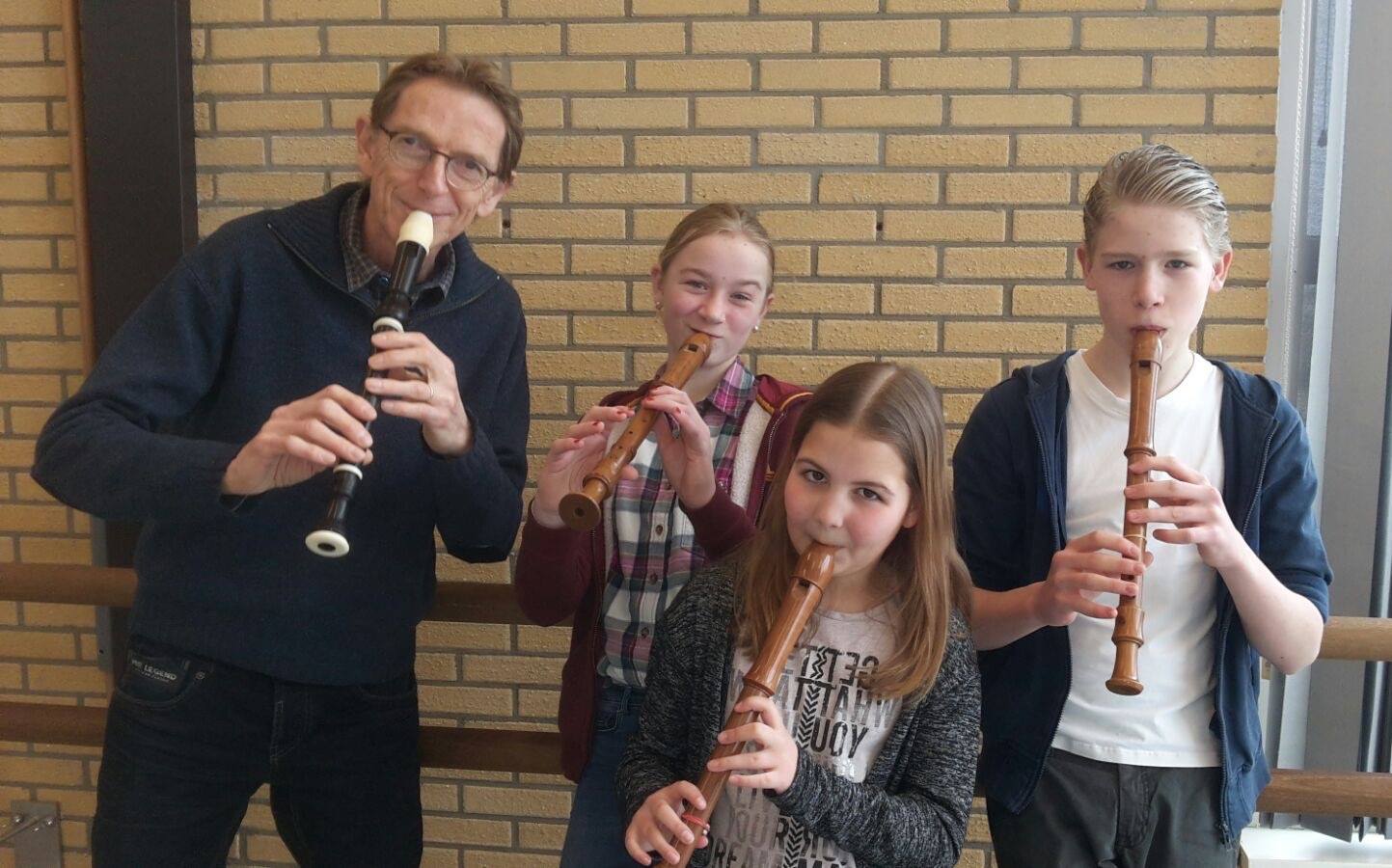
Besides individual lessons, there are also regular group lessons, where children have lessons together. Group lessons are very important in the Suzuki method because they reinforce what has been learnt, enable playing together, provide an environment where they learn from peers and provide lots of fun through all kinds of games and new, unexpected angles.
Concert day
During the year, there are a number of ‘concert days’. On a Saturday afternoon, all recorder students come together and play with each other (at the large group lesson) and before each other at the concert. Their parents, family and friends are of course welcome to attend.
The morning ends with a social gathering where the goodies brought along are eaten and drunk.
The schedule of group lessons, concert days and holidays will be announced at the beginning of the school year.
Mother tongue method
With the Suzuki method, children learn to play an instrument the same way they learn to talk - by hearing and imitation. So they call it the mother tongue method. The younger you start it, the better it is. That is why children can start with me when they are between 3 and 8 years old. The approach is very playful and focused on your child's developmental stage.
Parents
As with mother tongue learning, the role of the parents (or one of them) is very important. He or she joins the class, also learns the first principles and can thus be the example for, and give encouragement to, their child. But you don't have to be musical as a parent, the most important thing is the positive attention you can give your child.
Hearing
In the beginning, learning goes by ear. The beautiful music is on CDs or mp3s that are regularly played at home or in the car, so your child quickly picks up the beautiful melodies and acquires musicality. It thus acquires a sharp musical ear, so that after a while it can effortlessly imitate songs it hears.
Notation
Notation is introduced the moment your child has a good level of playing. Just like children don't learn to read and write until they can talk properly! Even when a student is more advanced and can read notes well, he/she eventually plays all music by heart.
Collaboration
Although the Suzuki method pays a lot of attention to each child's individual development, there is regular playing with other students, for example on group lessons and concert days.